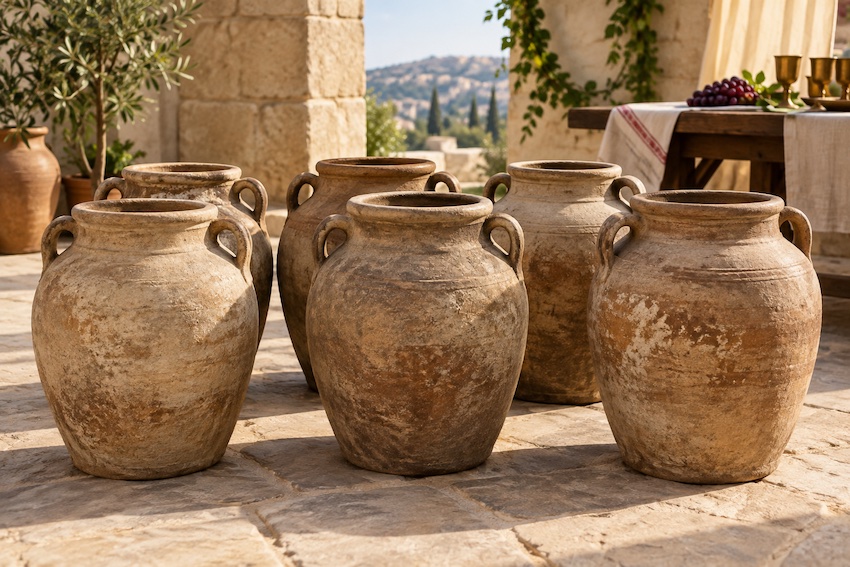
The wedding at Cana in Galilee is still relevant today
Early in the book of John, we get a little glimpse into Jesus’s personal life. He and his mother were invited to a wedding at Cana in Galilee. And even the few disciples Jesus had asked to follow him were invited as well.
It would be easy assume either the bride or groom or both, were family friends of Jesus and his mother. It was a time of happiness and celebration for everyone.
At some point during the festivities, the hosts ran out of wine. Mary was quick to pick up on this development and went directly to Jesus to tell him the situation.
Have you ever wondered why she did this? Was it just simple information she was casually passing along or did she expect Jesus to do something about it?
It seems pretty clear that she expected him to respond with some solution based on his response.
And Jesus said to her, “Woman, what do I have to do with you? My hour has not yet come.” John 2:4 LSB – Legacy Standard Bible
In the context, it does seem Mary is trying to get Jesus involved in some way to solve the problem.
Jesus is not being disrespectful
Just as a side note, it used to bother me that Jesus called his mother “Woman.” It seems a bit disrespectful to my ear, but the Greek word here for “woman” is actually a term of respect.
According to Bible scholar William Barclay, the phrase, “what do I have to do with you?” is actually a Jewish idiom that means something like: Leave things to me, I’ll take care of this in my own way.
That changes the tone of what’s going on here and reveals much more tenderness in the way Jesus talks to his mother than most translations of the Bible convey.
The important part of Jesus’s response was, “My hour has not yet come.”
Jesus knew he was the Messiah at the wedding at Cana in Galilee
I used to think Jesus was being reluctant to inaugurate his ministry at this precise moment. And looking at this from my own perspective, I thought he didn’t want his mother telling him what to do.
But that’s not really what’s going on here. Jesus knew he was the Messiah. He knew the time was fast approaching, and already at hand, that his public ministry as the Messiah would be in full swing. He knew he had a great mission and purpose to fulfill. He was already gathering disciples to follow him and support his ministry.
There would be times in the future when Jesus said “My hour has not yet come.” He was thinking ahead to the culmination of his career in the crucifixion and resurrection.
For example, when his brothers encourage him to go to Jerusalem for the Festival of Tabernacles, he responds.
…You go to the festival. I am not going up to this festival, because my time has not yet fully come. John 7:8 NIV
And as he comes closer to the crucifixion, he declares,
The hour has come for the Son of Man to be glorified. John 12:23 NIV
Then just before his arrest in the Garden of Gethsemane he prays,
…he looked toward heaven and prayed: “Father, the hour has come. Glorify your Son, that your Son may glorify you. John 17:1 NIV
Jesus was not reluctant
I mention all this to show Jesus was not reluctant to show himself as the Messiah. He was completely conscious that he was stepping out into the public eye, well, partially public. You could say the wedding at Cana in Galilee was a private affair, but it was much more public than the privacy of his own home.
He knew he was stepping out into his Messiahship.
And then of course, the servants fill the six water pots with water and Jesus turns them into wine. The festivities continue. Very few people who were there knew at the time what Jesus had done. But the servants who had filled the jars with water, then took that water-turned-wine to the master of the feast, saw it with their own eyes.
And you can just imagine, they did not keep it a secret. Word spread fast.
John concludes the story this way:
John 2:11 NIV
11 What Jesus did here in Cana of Galilee was the first of the signs through which he revealed his glory; and his disciples believed in him.
Jesus first revealed his glory at the wedding at Cana in Galilee
Jesus revealed his glory. And more importantly, people, especially his disciples believed in him. This was proof to those Jesus had selected as his disciples that he was the Messiah.
Now, you may be thinking: Hey James, I love this story, and you’re right I hear it a lot at weddings, but you say this story of the wedding at Cana in Galilee can apply to my life every day? I don’t quite see that. I’m already married and I don’t remember seeing Jesus at my wedding.
Well, this story of the wedding at Cana in Galilee does have special meaning at a wedding. Obviously, it doesn’t mean that Jesus is going to show up in the flesh at someone’s wedding today. It’s about the spirit of Christ being present on your wedding day, and every day, to turn the water into wine, so to speak.
This is not about getting free wine. For you and me today, as well as those at the wedding at Cana themselves, this is mostly a metaphor for Christ being present in your life, taking something ordinary and transforming it into something needed and valuable.
Where there is no apparent answer to a problem, Christ always has a solution. When no one knows what to do, Christ knows exactly what steps to take.
The significance of Cana
Cana was a small, insignificant town, near Nazareth, where Jesus had lived much of his life up to this point. But it is significant Jesus chose this small country town in which to step forth as the Messiah. He didn’t begin his ministry in Jerusalem. He did not perform his first miracle in a royal palace or for the elite religious leaders of the Sanhedrin.
He chose a small, backwater village in which to first reveal his glory.
I find it very significant that Jesus stepped out into the public eye in a small, humble, country wedding.
The relevance of the wedding at Cana in Galilee today
So what does this mean to you and me? How is the wedding at Cana in Galilee relevant to our daily lives today?
Today, just as much as 2,000 years ago, Christ comes to humble hearts and homes, to participate, and join in the festivities, so to speak, as well as the everyday normal activities of life.
If you could invite Jesus to your wedding or special event, you would no doubt have him on the guest list.
But do you invite Christ into the humble routine of your everyday living? Not just the important events or the times of great need and urgency, but the normal, regular, sometimes boring day-to-day routines.
Is Christ on your daily guest list to participate in your life, the struggles you face, the choices and decisions you make, and the days when there is absolutely nothing special going on?
Christ transforms the ordinary into the extraordinary
When Christ is present, the ordinary day-to-day routines become inspired and purposeful, just as that plain, ordinary water became wine.
Christ takes what you see in your life as insignificant, boring, or inadequate and transforms it into joy and purposeful living.
The real miracle at the wedding in Cana at Galilee was not simply the water being turned into wine, but what it represented.
Each of those 6 water pots held 20-30 gallons. Do the math. That’s 120 to 180 gallons of wine. That is a lot of wine. It is hard to imagine the guests could drink all that wine, especially since they had already had quite a bit.
The real miracle at the wedding at Cana in Galilee
Jesus brought a sense of overabundance to this wedding in Cana at Galilee. This is the miracle, the manifestation of Jesus’s glory. And to emphasize this point he says later in his ministry,
I am come that they might have life, and that they might have it more abundantly. John 10:10 KJV
I love the way NIV puts it.
I have come that they may have life, and have it to the full. John 10:10 NIV
Just as the water pots were filled with water to the brim which was then turned into wine, Christ transforms the plain, simple, ordinary things that fill our lives to the brim and turns them into meaning and purpose. We discover an abundance of good, of joy, of inspiration, and so much more, when we invite Christ into our daily lives.
Jesus’s example of how to participate in society
Another important aspect of this story of the wedding in Cana at Galilee is that Jesus was no solitary monk in a cave, shut off from human relationships.
Over the centuries, there have been movements within the Christian church to be totally secluded from all contact with any other persons, or have limited contact at least. The idea was to spend time in prayer and get closer to God so as not be influenced by all the temptations and evils in the world.
There’s nothing wrong with having some alone time with God. Jesus certainly did. And it’s definitely a good idea to pray to be delivered from evil and temptations. Jesus took time to do this as well. But he also spent a lot of time with people, helping them, healing them, and loving them.
This is the example Jesus set throughout his ministry. He participated in the events of daily life. Not because he was lonely or wanted company, but that’s where the people were. That’s where he would find people who were receptive to and in need of his message of repentance and salvation.
In the world but not of it
Jesus’s participation in the festivities at the wedding in Cana at Galilee is relevant to you and me today because it gives us a model of how to interact with others, how to be in the world but not of it. That’s a popular saying these days, to be in the world but not of it. It comes from things Jesus prayed immediately after the Last Supper.
I will remain in the world no longer, but they are still in the world, and I am coming to you.
My prayer is not that you take them out of the world but that you protect them from the evil one. They are not of the world, even as I am not of it. John 17:11, 15, 16 NIV
Jesus was in the world but not of it. This is his desire for us as well. It’s okay to be participate in normal activities, celebrations, and special events.
It doesn’t mean you go to every party, every ball game, every political rally. But it does mean to go about your daily affairs with normalcy, according to your personal interests, and sometimes obligations. These activities can be opportunities for you metaphorically to have some water turned into wine.
Christ turned my water into wine
Years ago, I was invited with my parents to a huge social gathering to celebrate a family friend’s engagement to get married. I had just moved back to my home town after having been gone for about eight years and I didn’t really know too many people at this party.
Of the 150 folks who were there, within the first five minutes after I arrived, I met a young fellow about my age. We got into talking about spirituality, religion, God, and the Bible almost instantly and chatted for at least 45 minutes. And then we met for lunch every week or two to keep the conversation going.
The ironic thing is that I didn’t really want to go to this party. I thought these kinds of events were just for show and full of superficial people wanting to be seen, pretending to be important. How wrong I was. It turned out to be a huge blessing to me.
Christ took what I thought was going to be a boring party full of people mastering the art of small talk, with nothing important to say, and turned it into an opportunity to bless and be blessed with a deep friendship. Christ turned my water into wine.
This has happened many times in my life. I think I’m just going to the bank to make a deposit and I meet someone I end up talking to about God. I’m out in the yard pulling weeds when someone stops to say how beautiful the flowers are and we end up talking about God and His healing power.
I had never really thought of these situations as examples of Christ turning the water into wine until now, but that’s exactly what was happening.
The water into wine at the wedding at Cana in Galilee a perfect metaphor
Jesus turning the water into wine at the wedding in Cana at Galilee is a wonderful metaphor for how daily life can be transformed when we invite, allow, and acknowledge Christ in our lives.
And just like Mary, when you realize there’s a need or a problem in your life, it’s time to turn to Christ immediately for help.
You don’t have to wait for a special event like a wedding to experience Christ’s presence. Every day, every moment, Christ is with you, turning the water into wine, taking the ordinary things that fill your life, and transforming them into God’s glory.
_____________
James Early, the Jesus Mindset Coach, is a Bible teacher, speaker, and church mentor. He conducts Bible workshops online and in person. His focus is on getting back to the original Christianity of Jesus by learning to think, pray, and love like Jesus. Contact him here.
Make a donation to support the show
Listen and leave a review on



_____________
Bible References
John 2:4 LSB – Legacy Standard Bible
4 And Jesus said to her, “Woman, what do I have to do with you? My hour has not yet come.”
John 7:8 NIV
8 …You go to the festival. I am not going up to this festival, because my time has not yet fully come.
John 12:23 NIV
23 The hour has come for the Son of Man to be glorified.
John 17:1 NIV
1 …he looked toward heaven and prayed: “Father, the hour has come. Glorify your Son, that your Son may glorify you.
John 10:10 KJV
10 I am come that they might have life, and that they might have it more abundantly.
John 10:10 NIV
10 I have come that they may have life, and have it to the full.
John 17:11, 15, 16 NIV
11 I will remain in the world no longer, but they are still in the world, and I am coming to you.
15 My prayer is not that you take them out of the world but that you protect them from the evil one.
16 They are not of the world, even as I am not of it.