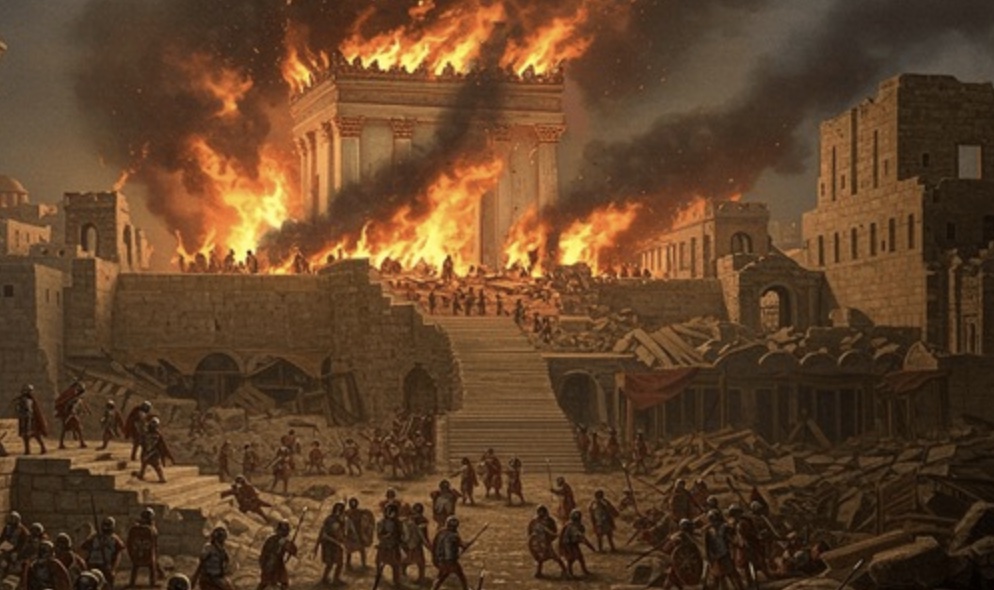
How is the destruction of the Jewish Temple relevant to us today?
Below is a complete transcript of today’s episode
James Early [00:00:00]:Hey there, and welcome again to the Bible Speaks to you podcast. I’m so grateful you’re here today listening, and I hope you’ll think of someone to share this episode with as you’re listening. Recently, I’ve talked a lot on the podcast about the early Christian church and how we can learn from what happened in the Book of Acts. But there’s an event which had a really powerful effect on the early church that’s not mentioned in the Bible, although Jesus prophesies it, and that’s the destruction of the Jewish Temple in Jerusalem by the Romans in 70 C.E. My guest today, Ward Sanford and I are going to talk about the Temple being destroyed and how it affected the early church. And more importantly, we want to look at how this event and the early church’s response is relevant to us today and what we can learn from this event, which took place almost 2,000 years ago. Ward, welcome to the Bible Speaks to you podcast.
Ward Sanford [00:01:02]:
Thank you for having me, James. Looking forward to our discussion.
James Early [00:01:06]:
Yeah. I’m so grateful you’re here. I just want to tell all of you, listening. One of the things I love about Ward is that he is passionate about showing the historical and cultural context of the first century Judea in which the earliest Christian church, well, it really struggled to survive. And as a result, he’s written an historical fiction series called The Cry for Jerusalem, and we’ll talk about that in a little bit. But at the heart of everything Ward does, it’s really his desire to get back to the roots of the Christian faith and explore these challenges that it faced in, I mean, it was a pretty turbulent time in the first century world and how that applies to us because we have a little turbulence going on in our world today, too.
Ward Sanford [00:01:52]:Yeah.
We talk about the destruction of the Jewish Temple
James Early [00:01:52]:So, Ward, usually I talk about stuff that’s mentioned specifically in the Bible and what Jesus said and what we can learn from the prophets and those kinds of things. But today, as I said, we’re going to talk specifically about the destruction of the Temple in 70 AD. Why do you think the Temple being destroyed, why is that so important for us to know about today?
Ward Sanford [00:02:15]:Wow. So let me say my. My series picks up where the, you know, the New Testament ends. So the New Testament ends and early 60s with Paul on his way to Rome.
James Early [00:02:27]:Right.
Ward Sanford [00:02:27]:And my. My series picks up in the end of 63 through 70 and the destruction of the Temple. This is the whole setting the early church was birthed in. Right. And all of the tribulation, a lot of what Jesus speaks to. And you alluded to his prophecy that the Temple going to be destroyed soon and what hardship the people were facing. So my goal here was to present the whole culture and put it in a novel series in the way that people could really feel what it was like to be there. But at the same time, the whole series is based on the writings of the historian Josephus, who was there and very much involved in everything.
Ward Sanford [00:03:12]:So we have a lot of information of exactly what was going on.
What was the destruction of the Jewish Temple like?
James Early [00:03:17]:Yeah. Could you paint a little picture for us of what that time period was like? You’re talking about early 60s to the fall of the Temple. What were the times like for early Christians at that point?
Ward Sanford [00:03:30]:Well, it was very traumatic because Nero was emperor and Nero instituted a large persecution of the church. In fact, there was a… The novel series takes you through a great fire in Rome that happened in 64, of which we know that Nero deliberately blamed the Christians on, even though they weren’t responsible, and began a very large persecution of the Christians, just to gaslight something he had been involved in, you know, so. Right. And then what happened was in order to try to rebuild Rome, they needed a lot more money coming in. So he sent out tax collectors to the provinces to help milk more taxes out of the provinces. And he sent this man named Gessius Florus to be the governor of Judea. This was really bad for the Jewish people because the governors at the time would also enrich themselves by levying taxes and half of it going to their own pockets.
James Early [00:04:31]:Right.
Four years before the destruction of the Jewish Temple
Ward Sanford [00:04:31]:And this is definitely what Gessius Florus did. In fact, he showed up and he knew there was a lot of gold and silver in the Temple treasuries. So his first thing he did was pick a fight with the Jews, attack Jerusalem and try to raid the Temple. And so at that time, the rebels who had sort of maintained a low profile, had had enough and they fought back in full force, that’s when actually in 66, the Jews managed to kick the Romans out. And so they were independent from 66 till 70, when General Vespasian came in with the Roman legions to put a final end to it.
James Early [00:05:09]:Wow. I didn’t realize that had happened in 66. So they had a four year period where they thought they had won.
Ward Sanford [00:05:17]:Yeah, they certainly thought they’d won in 66. And in fact, they started minting their own coins. That’s kind of a symbol of, “Hey, we’re in charge, we have our own coins.” So you can actually find little coins from that time period. But they call it the first Jewish revolt from those four years.
A lesson for us today
James Early [00:05:37]:Wow. You know, let’s take that little moment in history as a metaphor. It could happen to us personally, in our own lives. It could happen more collectively in the church. Sometimes we think we have overcome a problem, sometimes we think we have dealt with something, like I said, either individually or collectively as a church. But were there any signs during that four year period where it was obvious that they really hadn’t been completely victorious? And how can that help us today? We don’t want to be blindly thinking: Oh gosh, everything’s wonderful when evil is brewing.
Ward Sanford [00:06:12]:Yes, certainly, that’s, that’s what happened, in fact. So they managed to stop Gessius Florus from taking over the Temple, but Nero wasn’t going to have that. So he sent the governor of the time, one legion, to try to take back Jerusalem because they’d captured just Jerusalem. But that’s when the Romans lost. The rebels ambushed the legion. You know, they were all cheering. We’ve kicked them out. We’ve defeated a legion, a Roman legion, look how powerful we are.
Victory didn’t last
Ward Sanford [00:06:44]:But the following year, then Nero sent his general in with four legions. And this guy knew what he was doing, Vespasian. And so they slowly captured all the towns first in Judea before surrounding Jerusalem. Yeah, we can, we can be cheering and think everything’s wonderful, but the story’s not over. Right? Yeah, evil’s evil still out there and increasing in his forces. Right. He learns from his mistakes. So…
James Early [00:07:14]:Right, right. We can’t, we can’t ignore that sort of thing.
Ward Sanford [00:07:17]:Well, so the other thing that, that happened we can, we should, we should really learn from, is that it wasn’t long after the rebels took over Jerusalem that there were two main rebel leaders that wanted total control of the city. So for two years they basically had the city split up and were fighting each other.
James Early [00:07:37]:Oh, yeah, that’s.
Lack of unity
Ward Sanford [00:07:40]:So they were not at all unified. It was a major battle between these two factions, one out of Galilee and one from Judea. In fact, the worst thing they did was they got desperate to defeat their enemy and they burned each other’s food supplies in the city. And a week later, all the Romans show up and put a siege on the city. So now not only they’re surrounded, but they have very low amount of food.
James Early [00:08:08]:You know, that division that a house divided against itself, Jesus says cannot stand.
Ward Sanford [00:08:15]:Exactly. Wow.
James Early [00:08:17]:How can you see the Christian Church today learning that lesson?
Ward Sanford [00:08:22]:Well, it seems to me our country is so divided, Right. That all we’re doing is fighting and pointing the fingers at each other. Well, like he said, you know, a house that’s divided cannot stand. So, like, at that time, try to look past petty political squabbling and find common ground.
Different perspectives
James Early [00:08:40]:Yeah, yeah. Are you seeing that in your own life? Are you able to bring some of that to your situation?
Ward Sanford [00:08:49]:Well, my background, I’ve been a believer my whole life. Right. For 30 more years, I’ve been a scientist. I worked for the U.S. Geological Survey. I did research on groundwater and groundwater supplies, water resources. But trying to be a scientist and also being a Christian, I find myself in the middle of people pointing their fingers and battling from both sides. So I’ve experienced being in the middle of that almost my whole life.
James Early [00:09:20]:Interesting. So you can sort of see a little more objectively what’s going on and not get sucked into it.
Ward Sanford [00:09:26]:Right, right.
James Early [00:09:26]:Yeah.
Who should win a war?
Ward Sanford [00:09:27]:Right. You know, I always remembered this little story somebody told me. An older Japanese couple during World War II was being questioned by the U.S. authorities, saying, “Well, who do you want to win the war? Do you want the US to win the war or Japan to win the war?” His answer was, “If your mother and father were fighting, do you want one to rise up and kill the other one? Or do you just want them to stop fighting?”
James Early [00:09:57]:What a good answer. That’s a really good. That’s really good.
Ward Sanford [00:10:02]:So I felt like that a lot of my life, you know? So I just want these two sides to stop fighting.
James Early [00:10:07]:That’s a really powerful prayer, really. I’m going to really latch onto that. We want our side to win, and maybe that’s not the real answer.
Ward Sanford [00:10:16]:Right?
James Early [00:10:16]:Yeah.
Ward Sanford [00:10:17]:And the other side isn’t our enemy, really. We have an enemy. And let’s not forget who the enemy is. Like the Jewish rebels did. They forgot who the enemy was.
James Early [00:10:27]:Right.
Ward Sanford [00:10:27]:They were turning on each other while the enemy was gathering forces.
James Early [00:10:31]:That is a really good point for them. But it turns into a metaphor for us, I think.
Ward Sanford [00:10:37]:Right. It’s always true. Right.
The destruction of the Jewish Temple is relevant today
James Early [00:10:41]:So let’s come back to this event of the Temple being destroyed. Why is that so important for us to know about today? I mean, there’s so many questions I have about this. I know about it. I read a little bit about it. But I think, well, first I’ll say, why don’t we know more about it? Why is it not talked about more?
Ward Sanford [00:11:00]:That was the question I asked myself. I started… I found that Josephus had written a book called the Jewish Wars.
James Early [00:11:07]:Right.
Ward Sanford [00:11:08]:And when I started reading it and all the dramatic details that they know, everything that happened and all the drama, it’s like, how come I never heard of all of this? All I heard was one date. And this is what happened.
James Early [00:11:19]:Right, right.
Ward Sanford [00:11:20]:Didn’t know that so much drama was involved in all of it. That’s just fascinating to read. But to your point, why is it important to us? It was also the end of the Old Covenant. Right. No more sacrificing animals at the Temple. You know, even the Jewish rabbis had to adapt to this afterwards, try to explain to themselves why there was no longer a Temple and how do we move or in our Jewish religion, without a Temple. But Jesus had instituted a new covenant. So.
James Early [00:11:54]:Right. Well, so.
Ward Sanford [00:11:55]:And that’s where. That’s what we live in.
Effect of the destruction of the Jewish Temple on early Christian church
James Early [00:11:57]:So how did that affect the Christian church at that time? I mean, Jesus had said, when you see these signs, get out of the city, get out of Jerusalem.
Ward Sanford [00:12:07]:Right. And I think that’s probably a lot of the Christians did leave Jerusalem, probably paid attention to that warning. Yeah, it’s amazing. You read the Olivet discourse talking about there, Jesus describing the end coming, and you can really see that the destruction of the Jewish Temple was a fulfillment of much of that. In fact, he said, this generation shall not pass away. And so there were people there that didn’t pass away that that actually came.
James Early [00:12:36]:Well, you know, I’m really glad to hear you say that, because when I was a kid growing up in Texas, those passages in Matthew chapter 24 and Mark 13 and Luke chapter 21, which are all little different versions of what you’re talking about there, those were used as a prophecy for today and that Jesus was going to come back any minute.
Ward Sanford [00:13:01]:I must have heard the same thing when I was growing up. Right. This was like in the 70s, and they were trying to say, okay, one generation, and then Israel became a Nation in 1948. And then how long is the generation? And they were trying to make those predictions.
James Early [00:13:14]:Exactly. So it’s really heartwarming to me to hear you. And I think a lot more people are becoming aware that that’s what Jesus is really talking about. But getting back to what Jesus said there, referring to the Temple, it makes a whole lot more sense than trying to squeeze those prophecies.Ward Sanford [00:13:34]:
Jesus predicted the destruction of the Jewish Temple
Yeah. Well, so what I tell people is it seems what the disciples asked him were. Because he had just said, this Temple is not going to survive and not one stone will be left upon another.
James Early [00:13:45]:Right.
Ward Sanford [00:13:46]:So they asked him, when is that going to happen and what will be the sign of the end times? Basically that. So in their mind, that was probably the same thing. Right. So Jesus is answering two questions at the same time, but they don’t distinguish for us like which one of these is he answering? So when he says this generation will pass away, he’s talking about the Temple, but other things, he might be referring to something in the distant future.
James Early [00:14:15]:I think you just made a really interesting point. When Jesus spoke, we hear him through our own lenses. Yes, we filter what Jesus. And we do this today. We don’t mean to, but it happens sometimes. We filter what Jesus has said, like love your neighbor as yourself or love your enemies. We filter that and we sort of, oh, he couldn’t have possibly meant to love so and so that’s the way.
Importance of story
Ward Sanford [00:14:39]:It is a lot though, I think we ask him a question and we have in our own mind the kind of answer we’re looking for. And he’s sitting there thinking, well, how do I explain this to you? Because you’re not thinking about it quite right. Right. And so I think that’s a lot of times why he came up with parables, to try to explain, you know, in story form what really the answer was, not just giving them the kind of direct answer they might be looking for.
James Early [00:15:06]:You know, that is so true. And I found that in my ministry. I have a prison ministry. I go every week to a federal prison in Connecticut and do a Bible study there. And, you know, you can give people information, but when you tell them a parable, we made up some modern day parables. Just, you know, it’s metaphors of life and it makes the point so much better. Or you share an experience you had or a friend of yours had or someone you know, and somehow that sense of: this is a story that happened or could have happened, it could be a joke you tell that makes the point.
Ward Sanford [00:15:40]:Right, Right.
James Early [00:15:41]:Well, I’ve got a confession to make, actually. Years ago, when I was a young man fresh out of college, I felt like fiction was not true. It shouldn’t be used to teach things. It was just a waste of time. And I have, over many years have realized, oh, well, there’s a lot you can learn from a work of fiction. Any of the great classics, right? They’re novels. They’re not real people. Might be based on true elements, but here you’ve written an historical fiction series.
The Cry for Jerusalem book series
James Early [00:16:12]:There are four books in the series?
Ward Sanford [00:16:14]:There are four. And sometimes they don’t almost like that word fiction because people think, well, he just made everything up. But there’s so much material I was able to draw on out of Joseph’s writing that most of the characters are real, most of the events are real, but we can add a couple of characters. We can add Events that really fill out the whole story in a dramatic way that makes you really feel like you’re there and experiencing all the emotions people are feeling at the same time and make it come alive and memorable. To me, that’s the best way to learn history.
James Early [00:16:49]:Well, I agree with you. We home schooled our kids and we read a lot of historical fiction, if that’s the right word for it. Our kids could identify with, oh, this is what happened. They learned it. They remembered it better than just a bunch of dates and things. Dates and facts and names.
Ward Sanford [00:17:06]:Right.
James Early [00:17:07]:So have you heard from readers that that’s what’s happening when they read your books?
Ward Sanford [00:17:13]:Oh, yes. I mean, that’s so common that anybody prefers learning the history in a story with real people rather than just learning a bunch of facts and battles and all that.
Josephus wrote about the destruction of the Jewish Temple in detail
James Early [00:17:25]:So I’m going to ask you what you learned about, well, about the time period, obviously, but about the early church. I’ll say about yourself, about our current time. What did you learn by doing the research and writing these books?
Ward Sanford [00:17:41]:Well, yeah, so Josephus was actually a huge source. He didn’t, of course, he didn’t write… He wrote some very important comments and things, a few sentences about the church and about some of the people. He has a statement about Jesus and he has a statement, for example, about John the Baptist and James who was martyred and other people. But then, of course, I also got interested in other early church writers. For example, I was reading there was an important history written by a bishop named Eusebius, right. Lived in Caesarea in about 300 or year, 300 or so. So he gets quoted a lot.
Ward Sanford [00:18:24]:So I just found a modern copy and started reading it and wow. He just gives a lot of information of what the church had already written down and some of it which we seem to have completely ignored or forgotten. I’ve been a Protestant all my life, but perhaps Protestants, we are so focused on the Bible, which is a good thing, but then we just neglect other early writings at the time that tell us things.
James Early [00:18:49]:Yeah, I read Eusebius several years ago and I thought, oh my gosh, what a pretty detailed and graphic depiction of what some of those early Christians were dealing with, some of their persecutions and the ideas that they were talking about. What got you interested in this in the first place?
Ward Sanford [00:19:10]:Right. I was interested in Jerusalem. I went to Israel and visited Jerusalem in the year 2000. That probably was first thing that perked my interest and started looking at the Temple Mount there.
James Early [00:19:25]:Right.
The Temple
Ward Sanford [00:19:26]:And people have all kinds of ideas of what it might have looked like. And, you know, the most popular one, probably remember these from big growing up, too, talking about the Dome of the Rock being there and is the Temple ever going to be rebuilt? And what did it look like? Back in the day, as I investigated this, people started quoting Josephus. And the interesting thing is if Josephus’ statements agreed with what they thought, they would say, well, look, Josephus told us this, and if it disagreed, well, they just kind of dismissed him as saying, well, he exaggerated too much. So then that’s what got me interested. I finally decided, well, let me go try to read him for myself and see what I think. And then if you ever pick up the book called the Works of Josephus, it’s a long, dense history book that was translated into English probably 300 years ago. And it’s like, wow, this is a little challenging, but there’s a modern English translation of the Jewish Wars out that was much easier to read. And so that’s when I started reading gob smacked about all the details.
Ward Sanford [00:20:28]:And you just learn a whole lot about what happened at the time.
James Early [00:20:31]:Yeah, yeah, yeah. So I want to talk a little more about the difference that the fall of Jerusalem made to the Christian church. What did that do to the church? How did it respond? Did it make things more challenging? Did it give them a sense of freedom from the Old Covenant? A little bit?
Early Christian Churches
Ward Sanford [00:20:50]:Yeah. I would say that there were different churches in different parts of world. Right. So there was already a church in Rome. There were churches in Asia Minor, like Ephesus and Philippi, Thessalonica, the ones that Paul writes to. Then in Revelation, there’s this letter to the seven churches. So, right. The churches had spread out all over the place. Then there was a church in Judea.
Ward Sanford [00:21:13]:Yeah, Maybe I read this in Eusebius, but those churches were all the church in Judea, the person in charge, or the bishop, was always a was always a Jewish believer for long periods of time. So they were the ones probably still a little bit anchored in their Jewish traditions. And so that would have had the first enormous impact on them. The other churches across Asia Minor and Greece and Rome, Roman Empire, they’re probably farther removed and so had a less direct impact on them. They were. They were worried about the Romans coming and arresting them.
Ward Sanford [00:21:50]:They had plenty to worry about without thinking about what happened too much in Jerusalem.
James Early [00:21:54]:Yeah, yeah.
Jerusalem’s fall
Ward Sanford [00:21:55]:So what I was surprised about Eusebius. And so this seems to have been quite an idea that was persistent around there was that God had destroyed Jerusalem and the Temple because the Jews had rejected the Messiah and they saw that as God’s hand in putting an end to that. Partly because of their rejection of the Messiah. That was, that was a pretty strong feeling. You read Eusebius wrote 300 years later that this was like an act of God’s judgment. Just something I think the church probably doesn’t see that, much of us don’t see it that way anymore. But it was a prevalent concept back.
James Early [00:22:37]:That’s how people thought of it. That’s. Yeah, right, interesting. Let’s take that as a metaphor. When we are disobedient to God and something bad happens. Some Christians who say, oh, God is punishing that person.
Ward Sanford [00:22:52]:Right, right.
James Early [00:22:53]:Others feel like you kind of did it to yourself.
Ward Sanford [00:22:55]:Right, right.
What lens are you looking through?
James Early [00:22:56]:It’s kind of the lens that you look through. But to me the lesson is, okay, are we obeying God? Am I obeying God? Am I following Jesus to the best of my ability? Have I let Christ into all the nooks and crannies of my heart? Is there some little door that I have shut and won’t let him in there? That’s not good.
Ward Sanford [00:23:17]:Right. What did Jesus say? Don’t point out the speck in your brother’s eye when there’s a log in your own.
James Early [00:23:21]:Right, I’ve been trying to get those logs out of my eyes. Got a few of them out.
Ward Sanford [00:23:27]:So another interesting point was Josephus and he’s one of the main characters in the novels. What’s interesting is he was captured by the Romans.
James Early [00:23:36]:Well now he was Jewish, wasn’t he?
Who was Josephus?
Ward Sanford [00:23:38]:He was Jewish. He was an upper class Jewish, very educated, but was captured by the Romans. The Romans were then kind of using him. But he saw himself as sort of a self-appointed liaison. He was trying to get Jerusalem to surrender so that the Romans wouldn’t destroy the city and the Temple. Of course he failed then and to the rebels eyes he’s over there working for the Romans. So Josephus was known by the Jews as a traitor for centuries. Even though afterwards he wrote down so much of the history.
Ward Sanford [00:24:09]:They owe him a great deal for writing down so much history that they now still have his writings. He would say, tell the Jews you’re bringing this upon yourselves. You should recognize that God establishes kingdoms and brings down kingdoms and that Rome is in power now because God allows them to be. And you should be careful, otherwise you’re going to find yourself fighting against God’s elect. But it almost sounded like that this is what he said, this is what he writes in his Jewish Wars. Of course. What’s interesting is he’s almost been befriended by the emperors. And he’s actually writing this for the Emperor Titus at the time.
Did God put Rome in power?
Ward Sanford [00:24:53]:Vespasian started out being the general, he ended up being emperor. His son took over. So his son Titus ended up being the general, laid the siege on Jerusalem. Then Titus became emperor. Josephus went to Rome and was living there basically writing this story because Titus had asked him to write the history of the war. Some people will argue, well, he’s biased because he’s Roman. And then other people will say, no, he’s biased because he’s Jewish. But that flavor comes out, that interesting flavor that Rome is there because God allowed them to be in control of the world.
Ward Sanford [00:25:25]:So you shouldn’t be fighting against them, you should just be cooperating with them.
James Early [00:25:29]:That’s a question we have today. How much do you live in the world, but not of it? How much do you go along with modern day society?
Ward Sanford [00:25:37]:Right. How much do you fight against the current civil government?
James Early [00:25:41]:Yeah. And how much do you just focus on following Jesus?
Ward Sanford [00:25:46]:Right.
Jesus didn’t get involved in politics
James Early [00:25:47]:I look at the life of Jesus, you know, he didn’t get involved in Roman politics.
Ward Sanford [00:25:51]:No. He didn’t say, go out and fight the civil government and take it over. No, he didn’t say that at all.
James Early [00:25:56]:He kept talking about his Father’s kingdom. It was not of this world.
Ward Sanford [00:26:02]:Right.
James Early [00:26:02]:Well, some people don’t have that figured out yet. Even the disciples, just before Jesus ascended, you probably remember this. I think it’s Acts, chapter 1.
Ward Sanford [00:26:10]:Right.
Jesus’s kingdom is not of this world
James Early [00:26:10]:They said, are you going to restore the kingdom at this time?
Ward Sanford [00:26:14]:Like, okay, now you’re really powerful. Yeah, you can restore the kingdom.
James Early [00:26:19]:They were still thinking of some geopolitical kingdom like David or Solomon.
Ward Sanford [00:26:25]:Right.
James Early [00:26:25]:They still didn’t completely get this vision that the kingdom of heaven is totally spiritual and that you could live in that. That that was here already. Jesus said, and it’s within us. I think it’s interesting, I want to come back to this point quickly that you said about the two rebel leaders and how the divisiveness between them really, it made destroying Jerusalem like a cakewalk almost for the Romans,
Ward Sanford [00:26:53]:It made it easier because unfortunately then the result of that was nearly a million people in the city starved to death.
James Early [00:27:01]:Wow.
Ward Sanford [00:27:01]:Because the siege lasted like two months.
Divisiveness is dangerous
James Early [00:27:04]:Well, let’s take that as a metaphor for how you and I and, and everybody listening today cannot get swept up in this divisiveness that seems to be pretty prevalent not just in the United States, but in other countries as well. It can happen politically. It can happen in different churches, different denominations, different religions. You know, when we are fighting against each other, we’re really on the side of the enemy.
Ward Sanford [00:27:31]:Right. We’re just helping out the enemy, making his job easier.
James Early [00:27:35]:It’s hard. Jesus said, love your enemies. Now that’s hard.
Ward Sanford [00:27:40]:Yes.
James Early [00:27:41]:Especially if there’s a war going on. But I think Jesus is always challenging us to find that sense of love that, that person, whatever they’ve done wrong, maybe they’ve done some really bad stuff, or maybe you just disagree with them. It could be a whole wide variety of things. But to love them as a child of God, whether they know they’re a child of God or not, Jesus didn’t give that qualification. He said, love everyone.
Ward Sanford [00:28:10]:Yeah. And in the way the novels are laid out, we have main characters from both sides. Right. That kind of reminds us that although we think we’re on a good side and the other side looks like the bad side, individuals are individuals. And you can have evil individuals on the good side and you can have good individuals on the evil side, “evil” side.
James Early [00:28:30]:Right, right. I know what you mean.
Ward Sanford [00:28:31]:Yeah, yeah.
How the destruction of the Jewish Temple helps us understand the Bible
James Early [00:28:33]:How can studying this particular event, the fall of Jerusalem, how can that help us understand the Bible better? How can it help us be a better follower of Jesus?
Ward Sanford [00:28:49]:Yeah. One of the reasons I wanted to write the whole series was simply to underpin and support the historicity of the early Christians and Bible being written there at the time. So what I tell people that the series is not pro Christian, it’s not pro Jewish, it’s not even pro Roman. It’s taking individuals from all the sides and allowing them to move through. Although there’s a lot of interactions with Christians, one of our main characters is a Roman soldier. He ends up being a Praetorian Guard in the prison in Rome and runs into Paul, who’s still in prison there.
James Early [00:29:24]:Oh, that’s handy.
Ward Sanford [00:29:26]:Yeah. Right. So, yeah, I wanted to just… And just reading and having real characters there makes you realize this was. This was real and it really happened. Makes everything just feel so much more real to them.
James Early [00:29:39]:Yeah. You know, I’ve had that feeling when I watched the Chosen. Have you watched the Chosen?
Ward Sanford [00:29:45]:Oh, yeah, right. It makes people feel. Makes them feel human. Right. Especially the disciples. Yes.
Bible brought to life
James Early [00:29:51]:I’ve been reading the Bible ever since I was in second or third grade. We always read the Bible in our home. I’ve known these Bible stories forever. And you read them and you say, yeah, yeah, yeah, I know that. And you read a different translation, gives you a little different flavor. But when you’re so familiar with something you sort of turn it into an icon. You turn it into a morality lesson. But I can see the value of your…
James Early [00:30:17]:Now you’re talking about these books you’ve written or the Chosen or whatever.
Ward Sanford [00:30:21]:Right.
James Early [00:30:22]:When it makes it feel like, oh, my gosh, I know those are actors, and I know this is just a book that Ward wrote, but it makes me realize, oh, it could have been like that. It could have been different. But you realize, wow, this really was true.
Ward Sanford [00:30:39]:These people were living their lives and having the same emotions we did and the same kind of thoughts we did and doing the same kind of thing we do.
Inspired by others
James Early [00:30:47]:Those kinds of things make me want to do a better job of following Jesus. You know, they make okay if they could do that.
Ward Sanford [00:30:55]:Right.
James Early [00:30:55]:I just finished reading a historical fiction of St. Patrick. He was quite a guy. It makes you realize, okay, well, I can step up to the plate a little more here.
Ward Sanford [00:31:07]:Right. They suddenly come off their pedestals and look like real people. Like, well, I don’t have to be on a pedestal. I’m a real person, too, so I can have a relationship with Jesus just like they did, because, okay, they just put their pants on the same way I do everywhere.
James Early [00:31:23]:Or their toga.
Ward Sanford [00:31:26]:Whatever they were wearing. Yeah. Their robes or. Yeah.
James Early [00:31:29]:So now let’s come back to this question I almost asked you. And that is, how does this event of the Temple falling and all the things that happened, because how does that speak to us today? What are the lessons we need to learn? What are the things we should not be doing? What are the things we should be doing or could do? We’ve talked a little bit about that. I’d just like to dig into that a little more.
Learning from fictional characters
Ward Sanford [00:31:54]:Yeah. I just wanted to tell you about one of our characters, because she did kind of become a metaphor for what people can fall into. Right. And it’s actually one of people’s favorite characters, because we decided we would give Josephus a younger sister, even though he didn’t say he had one. But we wanted to have some strong female characters in there, too. And so this girl Miriam, gets attacked by Roman soldiers. She’s still single, although she had been pledged to be married, she was still single, but she got rescued, fortunately by one of the members of the Shikari. Now, the Shikari were Jewish assassins.
Ward Sanford [00:32:36]:This is true. This group existed at the time, would go after Roman collaborators. So she secretly, she’s living at home, but secretly on the side, she’s being trained to become an assassin. So.
James Early [00:32:48]:Oh, wow.
Revenge is never a good idea
Ward Sanford [00:32:50]:She thinks she’s getting revenge, right, on Romans by doing this. And so she, she not only becomes one of them, she becomes anonymous, feared one of them. But in the end she ends up having to target people she doesn’t want to have to target. And in the end she comes to the realization that she’s gone down this dark road that has not led her to anywhere she wanted to be. And that it was all pointless, that revenge, never satisfied, that she just never could rectify what had happened. Right. It’s kind of an analogy for us.
Ward Sanford [00:33:28]:When people go out on a life of trying to get even with people who have wronged you, it’s never going to satisfy.
James Early [00:33:34]:That’s so true. And I’m sure there are lots of other things in your books that are like that. If we can learn the lesson from somebody else’s mistake, that’s always better.
Ward Sanford [00:33:44]:Right? Mistakes, yes. Right.
Aha moments
James Early [00:33:47]:That’s another thing about story, whether it’s fiction or the actual history, if you can see yourself and have those aha moments like oh my gosh, I made the same mistake or I did the same thing.
Ward Sanford [00:34:00]:Right.
James Early [00:34:00]:Or “Oh, that’s what I can do to solve the problem,” that self-awareness is really powerful.
Ward Sanford [00:34:06]:Right. I bet you other people see me that way, you know?
James Early [00:34:10]:What do you mean?
Ward Sanford [00:34:11]:Well, no, I mean that light bulb can come on when you’re reading a story like this. It’s like you’re seeing somebody and then suddenly you can think, do I behave like that? Are other people seeing me that way?
James Early [00:34:23]:Oh yeah, maybe you’re the light bulb for somebody else. You mentioned this strong female character in your book. Were there strong women leaders in the early Christian church?
Strong women
Ward Sanford [00:34:36]:Yeah, the series doesn’t really follow up on that. So I’m not sure I have an answer for that. We have two strong women series, but one of them is the Jewish young woman and the other one is a Roman upper class woman who they meet on a ship going to Rome. And it turns out she is the best friend of Nero’s wife. And so you can read about her. Actually, her name is actually Google and it’ll come up. Her name was Cleopatra. She goes by Cleo for short.
Ward Sanford [00:35:04]:Right. Nero’s wife’s name was Poppaea and it’s known that they were sympathizers, Jewish sympathizers. So they had some sympathy and interest in the Jewish religion and. Right. Cleo becomes a very interesting. And what happens is that she becomes married to this Roman governor of Judea, Gessius Florus, who is the antagonist of the whole story. He’s the bad guy. Right.
Ward Sanford [00:35:30]:So we find out this woman who’s sympathizing with believers, married to the worst enemy of the believers. Right. And so how does she survive that and deal with that?How does a woman deal with somebody when you’re married to somebody not a believer? But it’s hostile.
James Early [00:35:48]:Well, and that’s an issue I know a lot of women are facing today.
Ward Sanford [00:35:52]:Right.
James Early [00:35:52]:Sometimes a spouse will call themselves a believer, but they’re not acting like a true follower of Christ. And how do you deal with that?
Ward Sanford [00:36:01]:Right.
Same problems today as 2,000 years ago
James Early [00:36:02]:The more we talk, Ward, the more I’m realizing we’re living the same kinds of issues today that probably have always been, different settings, different characters, but some of the same issues are there.
Ward Sanford [00:36:18]:We get motivated by the same things and behave in the same ways. Right. That hasn’t changed.
James Early [00:36:23]:Yeah. We’re afraid of things.
Ward Sanford [00:36:25]:Yeah, yeah, yeah. We’re afraid of the same things. Right.
James Early [00:36:28]:I’ve not read your books yet, but I’m going to check them out. It’s almost like an adventure story, but with a bigger message and a historical import.
Ward Sanford [00:36:38]:Yes.
James Early [00:36:39]:I’m fascinated. You’ve got me all interested now and curious about that time period.
Ward Sanford [00:36:47]:About the characters or about history or how it applies today.
What’s next for the Church?
James Early [00:36:51]:So here’s what I want to ask. Where do we go from here as Christians, individually and collectively, as a church? What do we do next? What do you think is next? If God was going to give us a to do list, what is it that we need to focus on so this sort of thing doesn’t happen again?
Ward Sanford [00:37:12]:Wow. I have to realize every day that I don’t have control over the world, so there’s no way I can keep anything from happening that’s going to happen. I have to realize that I’m not in control, but God knows everything that’s going on, and so I have to focus on my relationship with Him. Right. That’s what he wants anyway. Right. He just wants us, of His children, to have Him live his life through us and focus on that relationship. I know my own personal walk changed dramatically when I changed that orientation…
It’s about relationship
Ward Sanford [00:37:44]:from what do I have to do sort of every day to keep in his good favor to realizing He just wants a relationship with me and focus on Him, the lover of my soul. You know, I’m also part of a counseling ministry called Network 220, and 220 is for Galatians 2:20. I’ve been crucified with Christ. It’s no longer I who live, but Christ lives in me. So I focus on Him living in me every day. I can go to Him for comfort and for guidance or whatever. He will guide me, what I can do in my limited sphere, and not to try to stop the world from going to where it’s going because I don’t have control over that. Right.
James Early [00:38:29]:You know, that’s an interesting point. What is the most influential thing we can do? And I think it is to walk the way Jesus told us to walk, to think and pray and love like he did.
Ward Sanford [00:38:43]:Right.
James Early [00:38:44]:That’s really my whole focus on the Bible speaks to you podcast is we’ve got to get back to what he told us to do, how he wants us to live, how he wants us to love and to be in relationship with him.
Ward Sanford [00:38:56]:Right.
Avoiding distractions
James Early [00:38:56]:We get distracted. The world has a lot of distractions.
Ward Sanford [00:39:01]:I really believe that the enemy is all about distractions. The enemy loves to distract us.
James Early [00:39:07]:Well, so let’s go there for just a minute. How can we not get distracted? Like the two factions in Jerusalem in 70 A.D. they got so distracted with opposing each other, they weren’t aware of the impending doom. What have you found, Ward, that helps you not get so distracted?
Ward Sanford [00:39:26]:Well, like I say, focusing on Him and relationships, close relationships I have with other believers who believe the same thing and reminding ourselves and telling other people that. I mean, his main command to his disciples of the Last Supper was love one another and how can I do that better? Right. Because I certainly could do better at that. And being aware of the tactics of the enemy, like to try to distract me and realize that, well, like Paul says, battle not against flesh and blood, but against the spiritual power. So realize that his goal is to try to distract me from that relationship and the power of the life of Christ.
Importance of community
James Early [00:40:11]:Yeah, yeah, I think you said something really important that is to be in community with other like-minded believers. Because there’s strength in that. Yes, there is so much strength in that.
Ward Sanford [00:40:24]:If we try to go it alone, the enemy loves that.
James Early [00:40:26]:So, yeah, I heard this analogy. Course this now is many years ago, but During World War II, the greatest fear of someone on a boat in the Atlantic was that their engine would fail and they get separated from the fleet. Because if a boat, a ship got separated from the fleet, the average life expectancy of that ship before it got blown up by the enemy, right. Was like, I don’t know, 20 minutes. I may be gotten that wrong. Maybe 30 minutes, whatever. It’s like that was the greatest fear. And someone used that as analogy to say, don’t be separated from the church.
James Early [00:41:04]:And I don’t mean the institution of the church, I mean the Community.
Ward Sanford [00:41:07]:Community of believers.
James Early [00:41:08]:Right, Exactly. We need that. I think God wants us to be in community with others that can strengthen us, that we can strengthen. I’m getting that as one of the main messages here in our conversation is we need to be unified. We need to work together. It does not always mean we agree on every little thing or every big thing, but let’s work together. Let’s love each other so we’re not caught off guard.
Ward Sanford [00:41:38]:Right.
Coming to a close
James Early [00:41:39]:We’re going to close here in just a few minutes.
Ward Sanford [00:41:41]:Okay.
James Early [00:41:42]:I just want to honor you, Ward, for everything you’re doing to help people understand the importance of this early historical period in the Christian church. I think a lot of people are not very much aware of it other than a date and a time. It’s so important for us to understand our spiritual heritage so we can go forward and not get distracted, as you were talking about. But also we can be and do all God is calling us to do and be. So I just want to honor you for that because I think through these books, and I’m sure everything else you’re doing now.
Ward Sanford [00:42:17]:We hear so many negative, critical messages out there in the world about, oh, well, the Bible was written, you know, generations later. I hear my certain friends and family members say these kind of things. And so it’s. It’s always good to reinforce that these were real people. This really happened at the time the Bible says it did. Yeah. Part of my goal was to reinforce that.
James Early [00:42:46]:Yeah, absolutely. Is there anything else that you want to mention? Any final thoughts you’d like to share?
Ward Sanford [00:42:56]:I can’t think of any. I might think of something an hour from now, but.
James Early [00:43:02]:Well, we’ve covered a lot of interesting ideas, and I really appreciate your time. I’m going to have your website and your contact information in the show notes.
Ward Sanford [00:43:13]:Right. CryforJerusalem.com, the website. It’s available on Amazon and paperback, Kindle and on Audible. You like listening to books?
Three questions
James Early [00:43:23]:Yeah, yeah. I will have all those links. For those of you listening, I would encourage you to check out Ward’s books. I think it’ll be a real eye opener, and we sometimes we need our eyes open to things. Ward, I always ask three final questions to all of my guests, and so you’re going to get them as well. The first one is: I f you could talk to any Bible character other than Jesus, who would it be and what would you ask them?
Ward Sanford [00:43:58]:Well, Paul certainly wrote a lot. He probably had one of the most largest influence. I heard my friend say this once, so I’ll Just have to repeat it. Not thinking of anything spectacular to say here. I’ll speak to Paul and I’ll say, Did you write the book of Hebrews? Yeah.
James Early [00:44:18]:That’s been a debate for a while, huh?
Ward Sanford [00:44:20]:Yeah. Right.
Question 2
James Early [00:44:22]:This is the second question. Is there any Bible character you especially identify with?
Ward Sanford [00:44:28]:Well, you have to think. There’s so many of them. You have to think a long time. I’ve never thought in those terms. So, I really like David because he was able to commune so much with the Lord out in, out on the countryside, in the hills, and nature and music and all of his songs. And so I love that part about him,
Question 3
James Early [00:44:53]:I like that, too. Here’s the third question. The Bible Speaks to You Podcast is about getting back to the original Christianity of Jesus. How to think and pray and love like he did. How would you describe, in your own words, Jesus’s original message of how he wanted this to live our lives?
Ward Sanford [00:45:14]:I would say he wanted to live our lives dependent upon him, in relationship with him. He also tells the story of the vines and abiding in him. And we get our strength, our life, through him, try to do it on our own. Outside of that relationship, we just struggle out of our flesh. All of our strength comes from that eternal relationship.
James Early [00:45:40]:Wow, I love that answer. Nobody’s ever answered that question quite that way. They just have sort of like an idea, well, we need to be more…
Ward Sanford [00:45:46]:Oh, okay.
James Early [00:45:47]:Loving or whatever. But I love the idea of this, and we’ve talked about this several times today. Is this relationship? I think that word relationship is really important. It’s not just information, right? The Bible is not just information. It’s about our relationship with God. Everything Jesus said, he wants us not just to obey him, he wants us to have that relationship.
Ward Sanford [00:46:10]:He demonstrated that for us, his life was all about depending on his Father. Right?
James Early [00:46:15]:Absolutely. Yeah, absolutely. So that’s great. Hey, Ward, I want to thank you so much for being here. I’ve really enjoyed getting to know a little more about you and this time period.
Ward Sanford [00:46:25]:Thank you, James.
∞∞∞∞∞∞∞∞∞
Photo credit:
 Ward’s Website: www.cryforjerusalem.com
Facebook – facebook.com/CryForJerusalem
Instagram – instagram.com/cryforjerusalem
_____________
James Early, the Jesus Mindset Coach, is a Bible teacher, speaker, and church mentor. He conducts Bible workshops online and in person. His focus is on getting back to the original Christianity of Jesus by learning to think, pray, and love like Jesus. Contact him here.
Make a donation to support the show
Listen and leave a review on



_____________