What does it mean to be a Christian?
Seventeen hundred years ago, in 325 C.E. the Council of Nicaea debated theological topics. The debates centered mostly on the identity of Jesus and what it means to be a Christian.
And here is where the mistake was made, which affects most of the Christian world today. In the end, the Council voted on who Jesus is and codified what it means to be a Christian based on accepting the doctrines outlined in the document of faith, which has since been called the Nicene Creed.
Let me say here, I don’t have a problem with a person, a group of people, an individual church, or a whole denomination writing out a statement of faith. It’s vitally important to know and declare your faith, which is what this creed does.
The problem with, in this case, the Nicene Creed, is in what was left out. While the Nicene Creed spells out clearly what would become the basis for Christian doctrine for centuries, there is nothing in the creed about how to live your faith, how to follow Christ and put his teachings into practice in your daily life.
What’s missing in the Nicene Creed
There is nothing about loving God with all your heart, and mind, and soul, and strength, or loving your neighbor as yourself.
There’s nothing about loving your enemies and forgiving. There’s nothing about repentance or caring for those in need.
None of these things Jesus told us to do are in the Nicene Creed.
Does that strike you as a bit odd?
The word “creed” simply means a set of beliefs and that is all it is. There’s nothing about living your faith or following Christ.
To be a Christian is more than a creed
Now you may be thinking right now: Hey James, it seems you’re coming on a little strong here against the Nicene Creed. They were trying to settle theological debates and find unity in their doctrines.
You’re absolutely right. But here again is the big mistake. The Council of Nicaea, and subsequent Church Councils, defined what it means to be a Christian by doctrine and not by the way you live your life. It regulated Christianity into a set of beliefs instead of being Christlike.
I go into much more detail in a previous episode as to why I do not adhere to the Nicene Creed. I’ll have that link in the show notes. Episode 224: Why Should I Believe in the Nicene Creed?
To briefly summarize, I cannot accept this creed because the leaders of the opposing viewpoints in the debates, Arius and Athanasius, did not act in a Christlike way before, during, and after these proceedings. If the creed is a result of their un-Christlike behavior, I’m not interested in who they say Jesus is.
Christlike behavior was not nearly as important to them as what they considered to be correct doctrine.
And the other reason I don’t accept it, as I said, there’s nothing about following Christ in this creed.
The mistake continues today
That rock thrown in the pond of church history by the Council of Nicaea still causes ripples in our time. A large portion of the Christian church today continues to define what it means to be a Christian by theological doctrines instead of doing what Jesus told us to do, living how Jesus told us to live, and loving how Jesus told us to love.
Again, you may be thinking: Wow, James. That’s a pretty bold claim. You’re really accusing the Church as a whole of not following Jesus. Who do you think you are to make such a claim? Who gives you the authority to pass such judgement?
Okay, fair enough. I don’t claim any special title or privilege to accuse the Church of 1,700 years of taking the wrong approach, except for my ability to read the Bible for myself, see what Jesus said on the subject, and to think for myself. And you have that same ability.
I’m not asking you to agree with me. You need to read the Bible, see what Jesus said about what it means to be his follower, and think for yourself, instead of being influenced or intimidated by centuries of traditions.
And by the way, just to be clear, a lot of people who define what it means to be a Christian by their doctrines are making a very sincere efforts to follow Jesus and obey his teachings as well. I’m very aware of that.
To be a Christian, can you believe anything you want?
Does this mean you can believe anything you want and still be a Christian, as long as you’re doing what Jesus said to do? If a person with no belief in God or someone from a different world religion does all the things Jesus says, does that make them a Christian? No.
The one thing Jesus’s immediate disciples had in common with those who came to believe in and follow Jesus in the book of Acts was that they recognized Jesus as the Son of God, the promised Messiah or Christ. This is the foundation of Christian faith. And it’s the basis for everything else I say here.
So let’s see what Jesus says it means to be one of his followers, one of his disciples. Or to rephrase it: What is Jesus’s definition of what it means to be a Christian?
Jesus: To be a Christian means…
First of all, Jesus knew that you could believe something and not necessarily practice that faith. In the Sermon on the Mount he made this point as clear as possible.
“Not everyone who says to me, ‘Lord, Lord,’ will enter the kingdom of heaven, but only the one who does the will of my Father who is in heaven.
Many will say to me on that day, ‘Lord, Lord, did we not prophesy in your name and in your name drive out demons and in your name perform many miracles?’
Then I will tell them plainly, ‘I never knew you. Away from me, you evildoers!’” Matthew 7:21-23 NIV
That’s pretty harsh language. Basically Jesus is saying you can call him Lord, in other words, you can believe the “correct” theological doctrine about who he is, but if you are not doing God’s will, you won’t taste heaven.
A lot of Christians need to wake up and start following Jesus on this issue.
Now just to give a little perspective here, when I first got serious about my faith in high school, I became very convinced I had the right theology about everything. I felt like I had to go out into the world and correct everyone else.
That didn’t go over too well. In fact, I had to eat a whole lot of humble pie. It was a very humbling process over many years to give up my self-righteousness and quit evaluating someone’s Christianity by their theology instead of how they followed Jesus.
How to be a Christian, a disciple of Jesus
So let’s come back to how Jesus defined what it means to be a Christian. Now, just as a reminder, the word Christian didn’t come along until years after Jesus was gone. So, Jesus didn’t use that term. He talked about what it means to be his disciple.
Here’s what Jesus says,
Then he said to them all: “Whoever wants to be my disciple must deny themselves and take up their cross daily and follow me.” Luke 9:23 NIV
Over many years I’ve had to deny myself, in other words I’ve had to let go of my strongly held opinions about God, Jesus, the Bible, the Church, along with other things religious, and keep coming back to what Jesus said instead of what someone else said or what my preconception was.
I’ve had to take up the cross of going against the world’s ways of doing things and strive to follow Christ.
Some Christians need to learn how to be a Christian
Based on some of the posts on Social Media I’ve seen recently, there are a lot of Christians who haven’t learned this lesson yet. They are still making the same mistake the Nicene Creed does. They argue about doctrine instead of talking about how to follow Jesus better. And they classify or declassify churches as Christian based on their theology instead of how well they’re doing what Jesus said to do.
This would be amusing, if it weren’t so sad is that one church will explain why they are the true church and have the correct theology, but in the process they vilify another church or many other churches.
And then someone from one of those other churches makes a video about how they are the true church and that the first church is incorrect in its theology.
All this infighting over doctrine, among people who claim to be Christians, but at the same time are not being very Christlike to those they disagree with, is far from what Jesus had in mind when he told Peter,
And I tell you that you are Peter, and on this rock I will build my church, and the gates of Hades will not overcome it. Matthew 16:18 NIV
Jesus did not, does not, build his church on doctrinal debates, but on revelations from God.
The rock Jesus if referring to is not Peter as a person, but the awareness, through revelation from God, who Jesus is. Jesus’s identity is revealed directly from the Father, not from votes at Church Councils, not from church traditions, not from intellectual debate.
Jesus demands a lot of us
How else did Jesus define being his follower?
Jesus demands a lot of us to be his disciples. He explains the kind of loyalty he expects and the cost involved.
“If you want to be my disciple, you must, by comparison, hate everyone else—your father and mother, wife and children, brothers and sisters—yes, even your own life. Otherwise, you cannot be my disciple. And if you do not carry your own cross and follow me, you cannot be my disciple.
“But don’t begin until you count the cost. For who would begin construction of a building without first calculating the cost to see if there is enough money to finish it? Otherwise, you might complete only the foundation before running out of money, and then everyone would laugh at you. They would say, ‘There’s the person who started that building and couldn’t afford to finish it!’
“Or what king would go to war against another king without first sitting down with his counselors to discuss whether his army of 10,000 could defeat the 20,000 soldiers marching against him? And if he can’t, he will send a delegation to discuss terms of peace while the enemy is still far away.
So you cannot become my disciple without giving up everything you own.” Luke 14:26-33 NIV
The word “hate” in this passage can also mean “to love less.” Jesus isn’t asking you to hate your family or yourself, but to love them and yourself less than you love him.
It takes commitment to be a Christian
But he is asking you to make a full commitment when you decide to follow him.
Does that mean that we are all supposed to literally give up everything we own and go live naked in a cave?
No, of course not. None of his immediate disciples did that. But they did put obedience to Jesus before anything else.
What do you need to give up to be a Christian?
What human opinions do you own that you need to give up? What selfish motives do you own that you need to give up? What pride and self-will do you own that you need to give up? What negative self-image and limiting beliefs do you need to give up?
I used to read this passage in Luke and think Jesus was talking about literally giving away everything I had. But he doesn’t say give away, he says give up.
Give up a personal sense of ownership and see yourself as a steward of what is already and always has been God’s. Give up dependence on people, circumstances, and material things, your human opinions.
It’s right to have what you need. Jesus calls it the daily bread you ask God for in the Lord’s Prayer. He says that God will give you everything you need when you get your priorities right.
But seek first [God’s] kingdom and his righteousness, and all these things will be given to you as well. Matthew 6:33 NIV
To be a Christian means obedience to Jesus
Another requirement Jesus makes on his disciples is obedience to his commandments and teachings.
If you love me, you will keep my commandments. John 14:15 ESV
Jesus makes it clear, it wasn’t just enough to believe in him superficially, or obey him blindly in a ritualistic, unthinking way. We need to abide in, to live in, to hold on to, his truth. This is how he puts it,
So Jesus said to the Jews who had believed him, “If you abide in my word, you are truly my disciples, and you will know the truth, and the truth will set you free.” John 8:31, 32 ESV
One of the fruits of being a disciple of Jesus, being a Christian, is that you will find freedom, spiritual freedom, from all the decoys and distractions the world puts in your way. But to be a disciple of Jesus, we have to abide in his word.
To be a Christian means to bear fruit
And another proof you are a genuine follower of Jesus is that you will bear fruit.
If you remain in me and my words remain in you, ask whatever you wish, and it will be done for you. This is to my Father’s glory, that you bear much fruit, showing yourselves to be my disciples. John 15:7, 8 NIV
Bearing fruit shows you are his disciple. That doesn’t mean you you’re going to heal every sick person you ever meet, walk on the water, and raise the dead. But it does mean your life will bear the fruit of following and obeying Jesus and being Christlike.
To be a Christian means to love
And the highest proof or evidence that you are truly a disciple of Jesus is the love you have for your fellow Christians.
“A new command I give you: Love one another. As I have loved you, so you must love one another. By this everyone will know that you are my disciples, if you love one another.” John 13:34, 35 NIV
This is the truest litmus test of all. Do you love your fellow Christians, even if you disagree on important and crucial theological points?
I know that some of these self-appointed Judges of Correct Theology think they are being loving by telling those they disagree with, they’re wrong. They love them so much they try to prove how wrong they are. I don’t know about you, but I don’t need that kind of love.
Now, there may be some genuine love somewhere in their heart for the people they disagree with, but it doesn’t feel like love when all that comes out of their mouth is self-righteousness, an I’m-right-and-you’re-wrong mentality, and condemnation.
I am so tired of all the theological debates among Christians. As I say in the intro to the podcast, I have a vision where we have enough humility to set aside our theological differences and all those doctrinal debates that get us nowhere, and instead we come together simply in loving and following Christ. It’s the only thing that will ever unite us as Christians.
What can you and I do?
So, what can you and I do to correct this centuries-old and ongoing mistake?
When you’re talking to someone you disagree with theologically, listen to them. Listen to their heart. Instead of debating doctrine, and trying to prove they’re wrong, get to know them. When they want to debate doctrine, instead ask how following Christ has transformed their lives. Ask them about the lessons they’ve learned from striving to follow Jesus’s teachings. Ask them why they follow Jesus.
It can be a wonderful experience to talk with someone you disagree with about their theological beliefs. But it should never be a debate or proving you’re right and someone else is wrong. It’s about learning where they’re coming from and why certain things are important to them. It gives you an opportunity to share what’s important to you and why without judgement or being judged.
When I have had these kind of conversations, I’ve come away with a greater appreciation for a fellow brother or sister in Christ. And I can begin to understand why they see things because of the perspective they’re looking at things from.
Learning from others instead of debating
Often, they bring up a point I had not considered, which is good because it makes me think in a fresh way. And I have always learned things that helped me clarify and strengthen my own faith.
And by the way, never pray for someone else to agree with you theologically. That is pure self-will. Once a lady, who disagreed with me on a major theological point, said at the end of the conversation that she would pray for me to see things and agree with her way. I’ve had this happen many times. I asked if she would like it if I prayed for her to see things my way. She said “No.” That’s what I mean by self-will.
I suggested instead we both pray to know God better and be more obedient to Christ’s commands. She could agree to that.
Jesus did not say to pounce on people with your theological doctrines. He said to let your love, your light shine into a world searching for hope.
…let your light shine before others, that they may see your good deeds and glorify your Father in heaven. Matthew 5:16 NIV
Those good deeds are the doing of what Jesus tells us to do.
To be a Christian means to follow Jesus
The more we follow Christ in every detail of our lives, the more like Jesus we will become, and the more those who do not know Christ will be attracted to the light and love we express.
I encourage you to think deeply about what it means to be a Christian. Do you define Christianity primarily by what you assume to be your correct theology? Or do you do you look at yours and others’ obedience to Christ in day to day living, thinking, acting, and loving?
To be a Christian is to follow Christ in thought, word, and deed. Let that be our standard for what it means to be a Christian.
∞∞∞∞∞∞∞
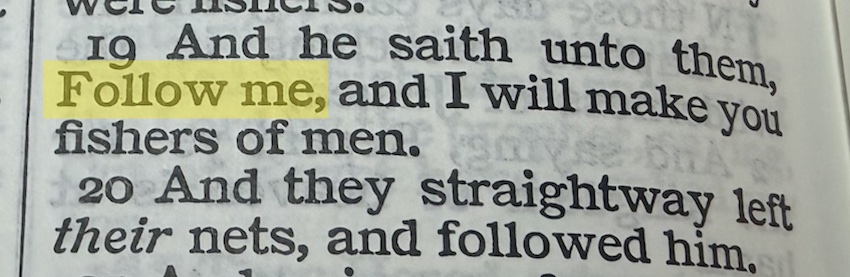
Photo Credit: Matthew 4:19
_____________
James Early, the Jesus Mindset Coach, is a Bible teacher, speaker, and church mentor. He conducts Bible workshops online and in person. His focus is on getting back to the original Christianity of Jesus by learning to think, pray, and love like Jesus. Contact him here.
Make a donation to support the show
Listen and leave a review on



_____________
Bible References
Matthew 7:21-23 NIV
21 “Not everyone who says to me, ‘Lord, Lord,’ will enter the kingdom of heaven, but only the one who does the will of my Father who is in heaven.
22 Many will say to me on that day, ‘Lord, Lord, did we not prophesy in your name and in your name drive out demons and in your name perform many miracles?’
23 Then I will tell them plainly, ‘I never knew you. Away from me, you evildoers!’”
Luke 9:23 NIV
23 Then he said to them all: “Whoever wants to be my disciple must deny themselves and take up their cross daily and follow me.”
Matthew 16:18 NIV
18 And I tell you that you are Peter, and on this rock I will build my church, and the gates of Hades will not overcome it.
Luke 14:26-33 NIV
26 “If you want to be my disciple, you must, by comparison, hate everyone else—your father and mother, wife and children, brothers and sisters—yes, even your own life. Otherwise, you cannot be my disciple.
27 And if you do not carry your own cross and follow me, you cannot be my disciple.
28 “But don’t begin until you count the cost. For who would begin construction of a building without first calculating the cost to see if there is enough money to finish it?
29 Otherwise, you might complete only the foundation before running out of money, and then everyone would laugh at you.
30 They would say, ‘There’s the person who started that building and couldn’t afford to finish it!’
31 “Or what king would go to war against another king without first sitting down with his counselors to discuss whether his army of 10,000 could defeat the 20,000 soldiers marching against him?
32 And if he can’t, he will send a delegation to discuss terms of peace while the enemy is still far away.
33 So you cannot become my disciple without giving up everything you own.
Matthew 6:33 NIV
33 But seek first [God’s] kingdom and his righteousness, and all these things will be given to you as well.
John 14:15 ESV
15 If you love me, you will keep my commandments.
John 8:31, 32 ESV
31 So Jesus said to the Jews who had believed him, “If you abide in my word, you are truly my disciples,
32 and you will know the truth, and the truth will set you free.”
John 15:7, 8 NIV
7 If you remain in me and my words remain in you, ask whatever you wish, and it will be done for you.
8 This is to my Father’s glory, that you bear much fruit, showing yourselves to be my disciples.
John 13:34, 35 NIV
34 “A new command I give you: Love one another. As I have loved you, so you must love one another.
35 By this everyone will know that you are my disciples, if you love one another.”
Matthew 5:16 NIV
16 …let your light shine before others, that they may see your good deeds and glorify your Father in heaven.