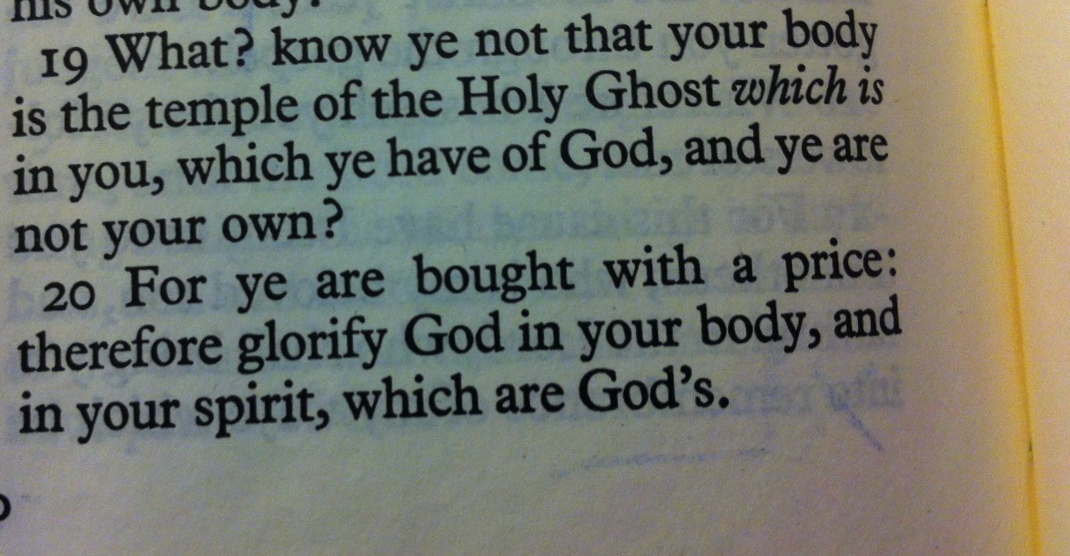
You’re probably familiar with the often quoted Scripture, I Corinthians 6:19, 20
Have you ever stopped to think what that actually means? It’s pretty amazing to think that the Holy Ghost, the Holy Spirit, the Holy Pneuma is inside each of us.
I have heard untold numbers of Christians quote these verses with such reverence and awe and earnestly accept the responsibility for what it means to them: to take care of their physical bodies because it is a temple.
(And I have known other people who start worshiping the “temple”–i.e. their body– instead of God. But that’s another issue altogether.)
But there was always something about this Bible passage that just didn’t quite sit right with me. And I never could quite put my finger on it.
There was something missing.
A couple of weeks ago in one of the classes I teach at the nearby Federal Prison, almost everyone in the class quoted I Cor 6:19 and vowed to take better care of their bodies. This is certainly important. We can’t ignore our bodies. We need to care for ourselves in the most practical way.
But when all these women kept referring to their bodies as the temple of the Holy Ghost, it prompted me to do a little research. I got out the Bible concordance and different translations of those verses. I went round and round the same familiar territory. Nothing new. No fresh insights. So I was just quiet and tried to listen for the “still small voice.”
Suddenly, it hit me like a bolt of lightning, a true BFO. (Blinding Flash of the Obvious)
How could I have overlooked this for so many years!
When Paul says, “your body is the temple of the Holy Ghost,” in the original Greek, the “your” is second person plural. He didn’t mean one person’s body. He meant the collective body of believers.
The difference between “thou” and “you.”
Now if you use a modern translation of the Bible, most of them do not distinguish between 2nd person singular and 2nd person plural. That’s why I love the King James Bible. Complain all you want about KJV, but I love it for lots of reasons and this is one of them. When I see the words, thy, thine, and thou, I know it is talking to one person. If it says you, ye, your, or yours, more than one person is involved.
This may seem like a minor little point. But think of the difference it makes with “your body is the temple of the Holy Ghost.” It does not say “thy” body. If it did, then I would have to say that all these folks are right who think the Holy Ghost is inside their bodies.
It does not say “your bodies are the temples of the Holy Ghost.” That could also mean that each of our bodies is a temple of the Holy Ghost.
What Paul is saying here is what he says elsewhere: “Now ye are the body of Christ, and members in particular.” (I Cor 12:27) Notice he says “ye” (you all) are “the”–singular, or one body. We are not each the body of Christ anymore than we are each the temple of the Holy Ghost. It takes all of us to be the body of Christ and it takes all of us to be the temple of the Holy Ghost.
And besides, the Holy Ghost could not fit inside one physical body or multiple bodies. It is too infinite for that. Nor can it be divided into bits and pieces. The Holy Ghost dwells in us collectively, not in each of us separately.
The Greek word “body” is used in a wide range of literal, figurative and spiritual meanings in the New Testament. In this verse it refers to the spiritual body of Christ, not the physical body or bodies of anyone, not even Jesus.
Our body, the one body of believers, the whole lot of us, is the temple of the Holy Ghost. It is a collective body and it does NOT refer to yours or anyone’s physical body individually or collectively. The body of Christ is the spiritual (not necessarily human) unity of all Christians.
Should we listen to men or to God?
This is another example of how some traditional Christian teachings have given people the wrong idea about what the Bible actually means. Hey, I know it’s sometimes hard to strip away and let go of these cherished concepts we have been taught and believed in all sincerity.
The New Testament was written in Greek. No person in the Christian church at Corinth reading or listening to Paul’s letter would have heard the “your body” as “thy body.” It was clear he was referring to something besides the physical body of an individual as the temple of the Holy Ghost.
If you have been inspired by the thought that your individual body is this temple, you may not necessarily appreciate what I have put forward. But don’t take my word for it. Search the Bible yourself. Find one that distinguishes between “you” singular and “you” plural. And let me know what you discover.
To be honest, I think this larger view of what constitutes the temple of the Holy Ghost is even more wonderful than this traditional teaching discussed here. It means we are all connected as members of the body of Christ. We cannot be a little island of faith unto ourselves. We are a collective whole of God’s creation, of His family. And we are united in the bonds of Christ’s love. We cannot ignore each other. We cannot be judgmental of each other. We can only worship God and be part of the body of Christ as we acknowledge the place and value of every one of our brothers and sisters in that same body.
WE ARE the temple of the Holy Ghost. Let us behave accordingly, individually and collectively.
Blessings,
James