
Thanksgiving: How and When Do You Thank God?
Sing unto the Lord with thanksgiving; sing praise upon the harp unto our God: Psalm 147:7

The Bible has so much to say about giving thanks to God.  We are supposed to thank Him in every situation and at all times.

But if we are to take the Bible only literally,  I’m in big trouble because I don’t have a harp.  And if I did, I’m not quite sure from the verse above if I’m supposed to stand upon the harp or not when I’m singing praises to God.  Hey, just kidding.

Fortunately, another Psalm says we only need to make a joyful noise when giving thanksgiving to God…

O come, let us sing unto the Lord: let us make a joyful noise to the rock of our salvation.  Let us come before his presence with

thanksgiving, and make a joyful noise unto him with psalms.  Psalm 95:1,2

I can certainly do that.  Some people say I have a nice singing voice, but sometimes when I hit a wrong note singing a hymn at church, I’m grateful that God hears in tune even if I miss a note.  More importantly, He hears the joy and gratitude in my heart.

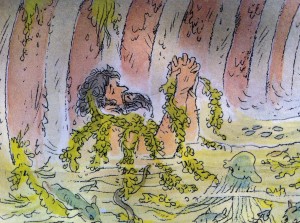
Jonah prays in the whale: Peter Spier, illustrator

We are also supposed to thank God when things are not all roses and sunshine.  Jonah learned this when he tried to avoid going to Nineveh to preach God’s message of repentance.  You know the story.  He ended up in the belly of a great fish aka “the whale.”  And guess what, he finally decided it was time for a little soul-searching prayer.

If you were inside that fish for three days and three nights I would imagine you would come to the same conclusion and pray your heart out.

You can read all of Jonah’s prayer, at least the part recorded in the Bible in Chapter 2 of Jonah.

I think it’s interesting that as soon as Jonah got to the point of offering up thanksgiving to God and vowed to be obedient it was then and only then that God commanded the fish to spit Jonah up on dry ground.   Here’s that part of the prayer…

But I will sacrifice unto thee with the voice of thanksgiving; I will pay that that I have vowed. Salvation is of the Lord. Jonah 2:9

Think about that.  Even in the “belly of hell” as Jonah called it, he found something to be grateful for.

Have you ever been in the belly of hell, felt like a whale of a problem has swallowed you up?  Sometimes we get there because we have disobeyed God and sometimes we get there because of what others do to us.  Either way, it’s time to follow Jonah’s example and pray to God with thanksgiving.

In every thing give thanks: for this is the will of God in Christ Jesus concerning you. I Thessalonians 5:18

Did you ever read the book The Hiding Place by Corrie Tenn Boom?  If not, I highly recommend it.  There is a scene when she and her sister are moved from one German prisoner of war camp to another during WWII.  The new barracks are just as disgusting and miserable as the previous ones with one additional misery: lice or something like that.  Corrie despairs over the lice, but her sister says that they must thank God for the lice referring to the verse above from I Thess.

Corrie thinks that is absurd.  But as it turns out, because of the lice, the German guards do not come back into their space and they are free to conduct their Bible study (which had been banned).

So it never hurts to Thank God in every situation whether it seems good or bad to you.  Frankly, I would be pretty hard put to thank God for lice, but it was those lice that gave them the freedom to worship God more freely and study the Word uninhibited.  Something to think about.

Is there something that is really irritating you right now, something  or someone who is a thorn in your side?  Well, try something a little different this Thanksgiving season.  Thank God for that situation or person.  This may be hard to do, but it is an opportunity for you to trust more in God to solve all your problems.  And who knows, maybe that thorn in your flesh you have been complaining about will be the very stepping stone to spiritual progress and freedom just as the lice were for Corrie and her sister.

When do we give thanks?

Most of us usually thank God after He has done something for us.  But we even forget to do that sometimes.  Remember the 10 lepers whom Jesus healed.  Only one of them came back to thank God.  I like to give the other nine a little benefit of the doubt and assume that at some point they remembered to thank God.  But Jesus commended the one who did it instantly.

Jesus set the example for us to follow.  He often gave thanks before something good happened.  When he fed the 5,000 people and when he raised Lazarus from the grave, Jesus offered prayers of thanks to God before he accomplished the deed.

Then they took away the stone from the place where the dead was laid. And Jesus lifted up his eyes, and said, Father, I thank thee that thou hast heard me.  And I knew that thou hearest me always:  John 11:41,42

We can pray with that same sense of gratitude and expectation that Jesus had.  He expected us to follow him in every detail of our lives.

Are you buried in the “tomb” of some problem with no seeming hope of escape.  Sounds like Jonah a little bit, doesn’t it?  Well guess what, it’s time for gratitude.  Time for a lot of gratitude.  Jesus’ prayer was not complicated, it was simple and to the point:  “Thank you Father for hearing me.  I know You always hear me.”  That is a good place to start.

I think it’s interesting that Jesus didn’t thank God for answering his prayer but just for hearing it.  Jesus knew that his Heavenly Father would indeed answer the prayer because it was offered in sincerity and had the purpose of glorifying God and helping people understand that God had truly sent the promised Messiah to the world.

In other words, don’t offer prayers of gratitude with secret hopes of personal gain.  Our prayers must be for the glory of God.  God will then give us whatever we need and will glorify us better than we could ever glorify ourselves.

There are so many other examples of the importance of gratitude and thanksgiving in the Bible.  But I will stop here.

I hope this Thanksgiving that you will find new ways to thank God for his many blessings and all the opportunities He has given you this year.

I’d love to hear your thoughts in the comment section below.

Thanks be unto God for his unspeakable gift.  II Corinthians 9:15

James


“Jesus Wept”

”Jesus wept.”    John 11:35

As every Sunday School kid who has to memorize Scripture knows, this is the shortest (and easiest to learn) verse in the Bible.

But its size is not indicative of the deep spiritual insight it gives into the thinking of Christ Jesus.

Why on earth would Jesus cry?

Was he sad, was he upset?  What was going on that moved him to tears?

Let’s set the scene.  It’s about a week before Passover (and Jesus’ crucifixion).  Jesus has just returned with his disciples to Bethany because he received word that his dear friend Lazarus was gravely ill.  When he arrives, he learns that Lazarus has already been in the tomb four days.  “He’s too late,” is what everybody’s thinking.

Jesus asks to see the burial place and begins to weep.  From the way he was crying, those around him could tell that Jesus loved Lazarus.  But they assumed he was sad.  And I have heard prominent preachers declare emphatically that Jesus was crying because he was grieving for Lazarus.

Nothing could be farther from the truth.

Did Jesus think he was too late?  Absolutely not!  He knew exactly what he was about to do.  He actually had delayed his arrival on purpose and had told his disciples that he was glad he had not been there so their faith would be strengthened when they saw what he would do (see John 11:6,15).

Jesus had a very different perspective on death, what it was—and what it wasn’t.  Jesus knew he would call Lazarus out of that tomb.

In fact, he had just comforted Martha that Lazarus would rise again. She thought he meant here-after, at the Last Day.  Jesus emphatically declared “I am the resurrection, and the life.”  Not was.  Not will be.  But here and now.  Jesus insisted he was the resurrection and the life that very moment—and every moment for all eternity.

But why did Jesus even go to the trouble of resurrecting Lazarus?  If Lazarus was going to be resurrected at the Last Day as Martha believed, what difference did it make?  In eternity, isn’t that all that really matters?

Obviously Jesus didn’t feel that way.  He took the grand truths of eternity and applied them to every day life.  The human condition was his laboratory for proving the omnipotence and love of God.

Take away the stone.

So Jesus comes to the tomb and he tells those nearby, “Take ye away the stone.”  Notice Jesus says “ye” which is second person plural.  It obviously will take more than one person to roll back the heavy stone at the entrance of the cave.

Martha’s immediate reaction was:  Why bother, he’s been in there four days and stinks by now.  How utterly disrespectful this action might have seemed to her.  She hadn’t yet glimpsed what Jesus was about to do.

Now just imagine how long it must have taken for a bunch of strong men to move that stone.  Probably a good long while.   If you had been one of the men rolling back the stone, what would you have been thinking at this point?   What was everyone else thinking?  How was their thinking evolving from being absolutely certain that Lazarus was dead, to curiosity as to what Jesus was going to do, and finally to expecting something amazing to happen?

The very command to roll away the stone helped to dissolve the conviction that Lazarus’ death was irreversible.  The removal of the stone allowed expectation to fill its place.  The stone represents fear, doubt, disbelief, and defeat.  It is the feeling of hopelessness in the face of all the material world throws at us.

And then of course, Jesus spoke those powerful words, “Lazaurs, come forth.”   And Lazarus stepped forth to the astonishment of everyone except Jesus.

So why did Jesus cry?

He was not sad.  He was not discouraged.  They were tears of joy, tears of victory and deep spiritual gratitude—gratitude to God for delivering Jesus himself from death after the crucifixion.

Jesus knew in a week’s time he would be facing his own death.  Lazarus’ emergence form the tomb foreshadowed Jesus’ own victory over the grave in his resurrection.  And Jesus knew it with absolute certainty.  God was reassuring Jesus that death could not defeat him.   It was God’s promise to his dearly beloved Son that death did not have the final say and that Christ destroys the power of death.

Christ has given us the victory over death.

Do we obey when Christ tells us to take away the stone?

Do we come forth when he calls us from the grave of sin, discouragement, and self-condemnation, etc.?

Obey Christ’s call.  Come forth.

“He is risen” in our hearts.

Happy Easter.